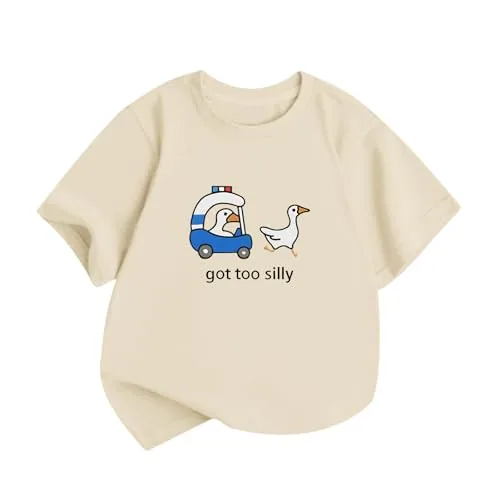
 Just words
T-Shirt
T-Shirt
100% cotton · cut for kids
Printed by Chipeler
4.7 out of 5 · 263 ratings$9.99
A small child announcing that they got too silly is the best version of this joke. Here is what changes when the shirt is for a child rather than for you.
This piece quotes a federal safety rule about children's clothing and explains how to read it. It is not a safety certification and it is not advice about a specific garment: the label and the certificate that come with an item are what its maker is answerable for.
Everything in the rest of this journal applies here too. The fibre content still predicts the feel, the care label is still the most useful thing in the neck, and the size letter still means whatever the maker decided.
Three things change. There is a real safety rule that applies to children's clothing and not to yours. Sizing works on a different system entirely. And the failure mode of a printed shirt is completely different when a four year old owns it.
This is the one piece of hard law in this article, and it is worth reading in the original because summaries of it drift. The Consumer Product Safety Commission keeps a list of substantial product hazards, and children's clothing with drawstrings is on it.
First, what counts as a drawstring at all.
Drawstring means a non-retractable cord, ribbon, or tape of any material to pull together parts of upper outerwear to provide for closure.
Non-retractable is the operative word. A cord that pulls out of its channel is the hazard, because it is the thing that catches on playground equipment, bus doors and car seats. An elastic band sewn shut into a hood is not a drawstring under this definition.
Then, which garments the rule reaches.
Children's upper outerwear in sizes 2T to 16 or the equivalent, and having one or more drawstrings, that is subject to, but not in conformance with, the requirements of ASTM F 1816-97
Two facts follow. The size range is wide: 2T all the way to 16, which covers most of a childhood. And the rule attaches to upper outerwear, which is the hoodies and sweatshirts here rather than the t-shirts.
You do not have to memorise a standard. You have to look at one photograph and ask one question: is there a cord hanging out of that hood?
On a compliant children's hoodie the answer is no, because the hood has no cord at all. Manufacturers solved this rule by removing the drawstring rather than by engineering around it, and that is how almost every children's hoodie now has a plain hood while every adult one still has laces.
So a cord in the hood of a garment being sold in children's sizes is a flag. It might be an adult garment listed in a children's size range, it might be an import that never met the rule, and either way it is a reason to choose the other one.
This trips up more gift buyers than anything else on the page. Children's clothing runs on at least three different systems and they overlap confusingly.
The number after a T is an age rather than a measurement, which means it is a guess about a specific child made by somebody who has never met them. If you know the child's height, the height on the size chart beats every letter and every number.
| Department | Things | Printers | From |
|---|---|---|---|
| T-Shirts | 79 | 28 | $9.99 |
| Sweatshirts & Hoodies | 44 | 18 | $12.49 |
| Long Sleeve Shirts | 13 | 6 | $17.99 |
| Tank Tops & Crop Tops | 37 | 16 | $15.27 |
| Kids & Toddler | 51 | 18 | $7.20 |
| Hats & Caps | 61 | 25 | $3.55 |
| Mugs & Drinkware | 83 | 35 | $2.99 |
| Tote Bags | 26 | 14 | $3.99 |
| Home & Wall | 30 | 17 | $5.19 |
| Pins, Patches & Gifts | 58 | 43 | $3.99 |
An adult wears a shirt and washes it. A child wears a shirt, sits in something, and the shirt goes in a hot wash that evening with everything else. That is the actual test.
Under that test the ranking flips. A soft direct to garment print, which is the nicest one to wear, fades fastest in repeated hot washes. A screen print survives longer but cracks if it is tumble dried hot, which children's clothing always is. A vinyl transfer, the shiniest and cheapest looking of the three, is actually the most robust against fading and the least robust against peeling at a corner.
There is no version that survives everything, so the honest advice is to buy the cheaper one and expect two good years rather than five.
Care label means a permanent label or tag, containing regular care information and instructions, that is attached or affixed in such a manner that it will not become separated from the product and will remain legible during the useful life of the product.
That definition is the reason to keep the label. On a child's garment it will still be legible long after the child has grown out of the thing, which is exactly when you are trying to work out whether it can be handed down or not.
It is worth understanding, because it tells you where to stop worrying. The hazard the rule addresses is entanglement: a cord that catches while the child is moving and the child is not. That needs a cord, and it needs a garment worn over other clothes in places with machinery, gates and vehicles.
A t-shirt has neither. So there is no drawstring rule for tees, and there is no reason to invent one. What a t-shirt has instead is a neck opening, and the only sensible check there is whether it will go over the head of a child who does not want it to.
Toddler tops solve that with a shoulder that unsnaps or a wider neck ribbing. Both are visible in a photograph, and neither is required by anything. It is simply the difference between a top designed for a toddler and an adult design shrunk down.
Children's clothing is bought once and worn by two or three people, which changes what a good purchase looks like. The garment almost always outlives the print.
By the time a shirt is handed on, the fabric has usually been washed sixty times and is softer than it started, and the goose has usually lost a little of its edge. A cracked print looks worse on the second child than a faded one, which is a reason to prefer the softer print over the crisper one if you already know the shirt will be passed along.
Colours matter here as well. Black holds a white print longest and shows every mark. A heather grey hides marks and dulls the print faster. Neither is wrong, and knowing which problem you would rather have is the whole decision.
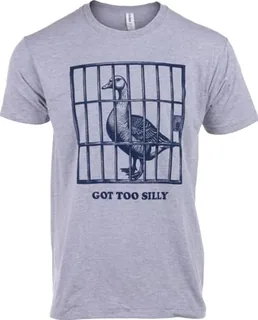
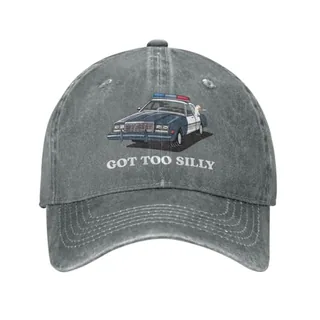
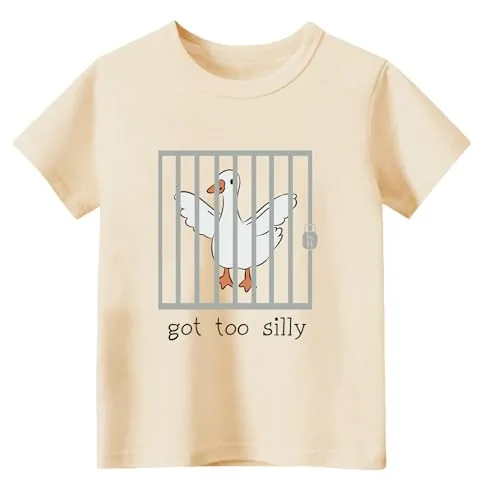
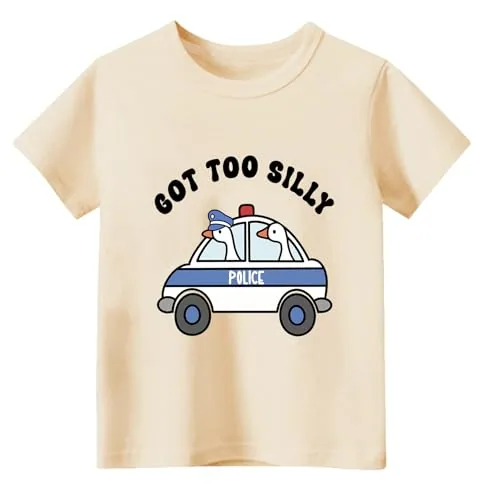
Worth asking out loud, because the drawing varies more than the words do. The plain pun version is a goose and a groan and is fine for anybody. The jail version has a bird behind bars, sometimes with a number board and occasionally with a mugshot frame.
Most people find that funny on a five year old and some people find it odd, and both reactions are reasonable. That is precisely why the version is on every card here and why every department page can be filtered by it: it is a decision, so it should be a visible one.
For a gift where you do not know the household, the plain version travels furthest. For a child who already finds the word silly funny, which is most of them, the drawing barely matters at all.
The kids department here carries 51 things, and every card in it shows the size the printer publishes and the version of the joke it carries. Nothing here is made by us and nothing here is certified by us: we read the product pages and put them on one page.
If the question is what a label has to say rather than what a child needs, the piece on reading a shirt label covers it in full.
Where this came from
Consumer Product Safety Commission
16 CFR Part 1120, Substantial Product Hazard List
Office of the Federal Register
16 CFR Part 423, Care Labeling of Textile Wearing Apparel
Every source above was opened and read on the date shown. Where a page says something we cannot check ourselves, we quote it and name it rather than restating it as our own.
Things this piece is about
Just words100% cotton · cut for kids
Printed by Chipeler
4.7 out of 5 · 263 ratings
In jail100% cotton · cut for kids
Printed by Chipeler
4.7 out of 5 · 263 ratings
Just wordscut for kids
Printed by Migxsaf
4.8 out of 5 · 15 ratings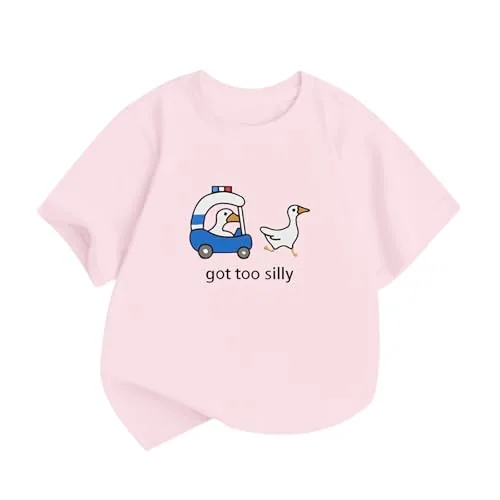 Just words
cut for kids
Printed by Migxsaf
4.8 out of 5 · 15 ratings